
Blog
Scuola Italiana Pizzaioli Italy Trained Chef in India

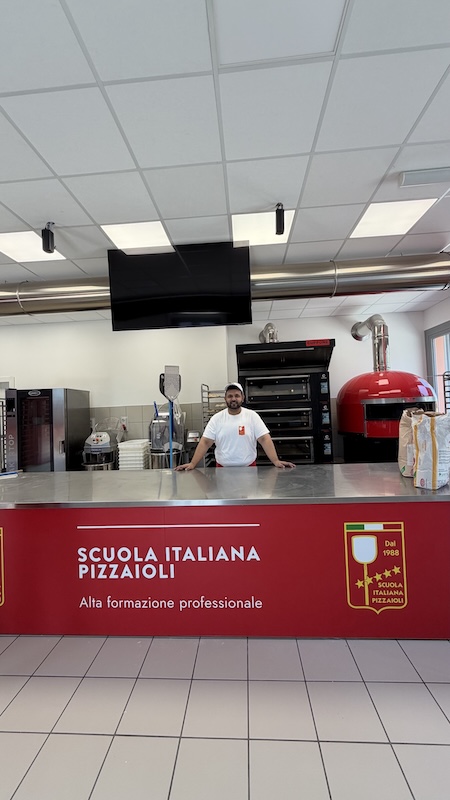
Advanced Pizza Training at Scuola Italiana Pizzaioli, Italy — And What It Changed About How I Teach Pizza in India
I’ve been teaching pizza in India for many years. I’ve watched students go from nervous first-timers who’ve never touched a dough ball to professionals who’ve gone on to run their own pizza kitchens. So when I decided to travel to Italy for advanced training at Scuola Italiana Pizzaioli — widely regarded as the world’s most rigorous pizza school — I wasn’t going to learn how to make pizza. I already knew that.
I was going to understand the Italian culture and age old traditions.
What I found there — in a professional kitchen in the Veneto region of northern Italy, surrounded by pizza chefs — was partly confirming the teaching methods we follow in India and partly humbling. And it changed specific things about how we teach pizza at Earthy Gourmet.
This is that story.
Why Scuola Italiana Pizzaioli?
Scuola Italiana Pizzaioli has become the benchmark institution for professional pizza education globally — training thousands of pizzaioli from over 50 countries, with accredited programmes ranging from foundational to master level.
I chose the advanced programme deliberately. I didn’t need to be shown how to stretch dough or construct a Margherita. I needed to be in a room where pizza was being treated as a science, debated as a craft, and held to standards that had been refined over 30 years. That’s what SIP offered.
The First Thing They Strip Away: Your Assumptions
The first morning in the kitchen, I was greeted by legendary Master Pizzaiolo Graziano Bertuzzo (multi-award world champion) and the schools technical director Tiziano De Filippis.
The session started with Graziano saying, “Everything is in the dough. If you are still thinking about toppings at this point in your career, we have work to do.”
It sounds obvious when you write it. But that single reframe — that toppings are a finish, not a feature — reorganised everything that followed. At SIP, the course is structured so that a significant portion of time is spent on nothing but dough. Not shaping it. Understanding it.
What "Advanced" Actually Means in Italian Pizza Education
Flour Classification and Its Real-World Consequences
Italian flour classification (00, 0, 1, 2, integrale) isn’t just a label system — it’s a direct indicator of protein content, ash content, and how the flour will behave under different hydration levels and fermentation times. We did comparative dough tests across flour types, with the same recipe, to observe the differences in extensibility, elasticity, and final crust structure.
The key lesson: the correct flour for a 24-hour cold ferment is not the correct flour for a same-day dough. Choosing wrong doesn’t ruin the pizza — it just means you’re working against your own process. Most pizza makers in India — and most pizza courses I’d seen — glossed over this entirely.
Fermentation as a Living Variable
This was the section that challenged most assumptions. Fermentation is not a setting you configure once. It’s a relationship between yeast activity, ambient temperature, dough temperature, hydration, and time — and every one of those variables shifts depending on your kitchen, your season, and your altitude.
What SIP teaches is not a fermentation recipe. It’s a fermentation logic — so that when your kitchen is 15°C in December or 38°C in a Delhi May, you know how to adjust. That’s the difference between a pizza chef and someone who can only make good pizza under controlled conditions.
Oven Management — The Skill Nobody Talks About
I had expected the curriculum to be dough-heavy. I hadn’t expected how much time we spent on oven management — and specifically, on reading a live fire.
A wood-fired oven at the right temperature is not simply “hot.” The floor temperature, the dome temperature, and the flame position all determine what your pizza will look like in 90 seconds. A floor that’s too hot gives you a burnt base and an undercooked top. A flame positioned incorrectly scorches the cornicione on one side.
We use brick ovens and deck ovens at Earthy Gourmet, the underlying principle — that oven management is an active skill, not a timer you set — translated directly.
What I Brought Back to Earthy Gourmet
Training at Scuola Italiana Pizzaioli didn’t change our programme’s structure. It sharpened its standards.
Specifically, after returning:
We extended our fermentation module. Students now run their own dough at different fermentation times and compare the results themselves. Understanding comes from doing, not watching.
We tightened our flour sourcing guidance. We now tell students exactly what to look for when buying flour in India — because the 00 flour available here varies significantly in quality and protein content, and knowing how to read a flour’s behaviour matters.
We added an oven literacy session. Students now spend dedicated time understanding how heat moves in a professional oven before they put their first pizza in. It sounds like a small addition. It made a measurable difference in outcomes.
The certificate from Scuola Italiana Pizzaioli hangs in our kitchen. It’s not there to impress anyone. It’s there to remind me — and our students — that there is a standard, it exists somewhere, and our job is to close the distance to it.
What This Means for Pizza Education in India
Pizza education in India is at an inflection point. The Indian market is beginning to recognise artisan pizza as a craft — not just a fast-food format. Consumer palates are maturing. Chefs who understand dough fermentation, flour science, and oven dynamics are going to be the ones building the restaurants and cloud kitchens that define the next decade of the Indian pizza industry.
What India needs right now is not just pizza courses. It needs pizza education built on the same disciplinary rigour that Italy has been refining for decades.
That’s what we’re building at Earthy Gourmet in Gurgaon. It’s what training at Scuola Italiana Pizzaioli reinforced.
If you’re serious about pizza — as a career, a business, or a craft — the standard exists. Come learn it.
Chef Ravin is the founder of Earthy Gourmet Institute of Culinary & Pastry Arts in Gurgaon, India. He completed advanced pizza training at Scuola Italiana Pizzaioli, Italy. Earthy Gourmet has been running professional Italian pizza programmes in India since 2022.
→ View our Professional Pizza Making Course
→ Check upcoming batch dates